Block or Monitor Sensitive Data Access by a Local AI Model using Purview Endpoint DLP

As AI tools become more prevalent on endpoints, how do we ensure they don’t get their virtual hands on sensitive files? In this blog post, I’ll walk through a hands-on lab using Microsoft Purview Endpoint DLP to block a Foundry Local AI model from accessing a classified document on a Windows 11 device. I also discuss options for deploying the themes covered in production.

Scenario: We have a document that we know contains sensitive data on a Windows 11 device, labelled as Confidential. We have another document on the same device that contains sensitive data and is not labelled. We’re going to use Microsoft Foundry Local (a CLI tool for running AI models locally) to attempt to process that file. With the right Restricted App policy in Purview, the AI model’s process will be blocked from opening the file. The policy settings can also be set to only Audit so that Endpoint DLP monitors the sensitive data usage.

We’ll set up everything from scratch: enabling Endpoint DLP, tagging a file as sensitive, adding Foundry CLI as a restricted app, creating the DLP policy, and then testing the block while capturing logs and evidence. Below is a 2 minute video showing what the user experience is like:

Let’s get started!


Pre-requisites

Licensing:

  • Microsoft 365 E5 or E5 Compliance license (for Endpoint DLP).
  • Audit enabled in Microsoft Purview (usually on by default in E5 tenants).

Device:

  • Device running Windows 11 Pro, Enterprise or Education

User Rights:

  • Local administrator rights on the device (to run onboarding scripts and install Foundry CLI).
  • Purview DLP admin permissions in the tenant (to configure DLP policies and restricted apps).

Step 1: Onboard Your Windows 11 Device to Purview Endpoint DLP

First things first – your endpoint (the Windows 11 PC) needs to be known to Microsoft Purview’s DLP service. This is done by onboarding the device to Microsoft Defender for Endpoint, which in turn lights up Purview Endpoint DLP capabilities. If you’ve already got the device in Defender for Endpoint, you’re likely set. If not, here’s how:

  • Generate an onboarding package: In the Purview portal (purview.microsoft.com), go to Settings > Device onboarding > Onboarding. Choose Windows 10/11 and download the onboarding script or the MSI package. (For Intune-managed environments, you can download an onboarding policy for MEM.)
  • Run the onboarding script: Copy the script to the Windows 11 PC (or use Intune to deploy). Run it as administrator. It will configure the device and register it with your tenant’s Defender for Endpoint. A reboot might be required.
  • Verify onboarding: After a few minutes, check the Devices list in the In the Purview portal, go to Settings > Device onboarding > Devices. You should see your device listed as onboarded. You can also run sc query sense in an elevated command prompt on the PC to see if the Defender for Endpoint sensor (“Sense” service) is running – a good sign.
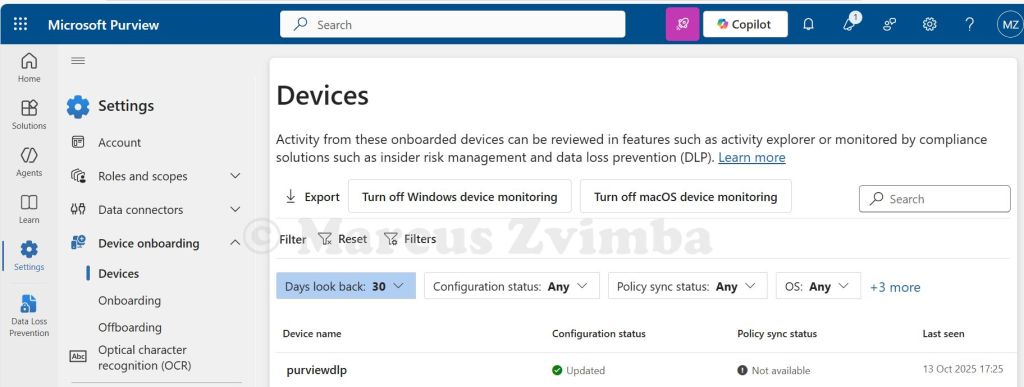
If the device shows up and is active, congrats – you now have an endpoint that Purview can protect with DLP policies. (“Enrolment” complete! ✓)

Note: Ensure the Windows user you’ll test with has an E5 Compliance licence assigned (since Endpoint DLP is an E5 feature). Also, enabling Auditing in Purview (via purview.microsoft.com > Solutions > Audit) is required so that all actions get logged. In an E5 tenant, audit is typically on by default.

Step 2: Prepare a Sensitive File to Protect

We need a file that our DLP policy will treat as sensitive. This could be any document containing confidential info or explicitly labelled as such:

  • Create a test file: For example, I opened Notepad and entered some dummy personal data:
Employee Salary List (Confidential)

Name: John Doe – Salary: £70,000

Credit Card: 4111 1111 1111 1111

Save this as SensitiveData.txt on the device. The credit card number will trigger built-in DLP detectors.
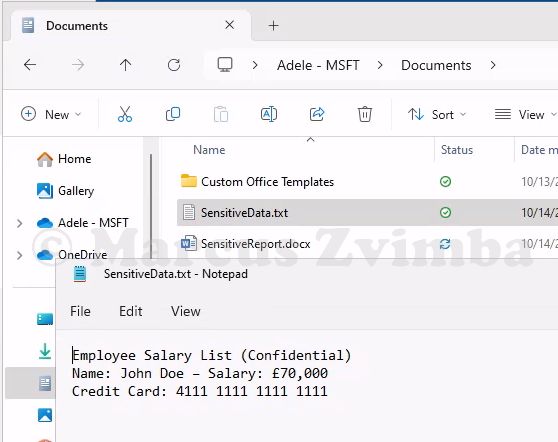
  • Create a second test file and apply a sensitivity label: Copy the text into a Word document but remove the credit card number. If you have sensitivity labels published (like “Confidential” or “Highly Confidential”) we can use these, otherwise you will need to publish a new Purview Information Protection sensitivity label. I saved a copy as SensitiveReport.docx and applied my “Confidential” label.
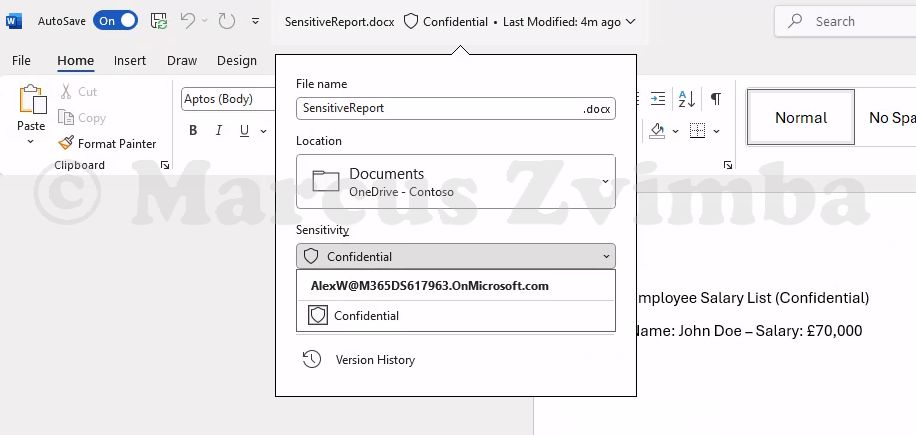
Now we have two files that are definitely sensitive. Purview can identify them either via the sensitivity label metadata or by scanning the content (e.g. detecting that 16-digit number as a credit card number).

Step 3: Mark Foundry Local CLI as a Restricted App

This is the pivotal configuration: telling Purview that the Foundry Local CLI is not allowed to touch protected content. Foundry Local is invoked via the foundry command. Under the hood, that’s an executable (on Windows it is foundry.exe). We’ll add that to the restricted apps list:

  • In the Purview portal, go to Settings > Data Loss Prevention > Endpoint DLP Settings > Expand Restricted apps and app groups.

Click Add an app:

  • App name: Give a friendly name like “Foundry Local CLI”.
  • Windows executable name: This must match the process name. In this case, type foundry.exe (the CLI later installed via winget uses this command). No need for a path, just the exe name.
  • (No need to fill Mac info for our Windows scenario.)
  • Auto-quarantine: Leave this unticked. (Auto-quarantine is more for things like Dropbox apps – not needed here, we just want to block.)

Hit Save. You should now see “Foundry Local CLI (foundry.exe)” in the Restricted apps list.
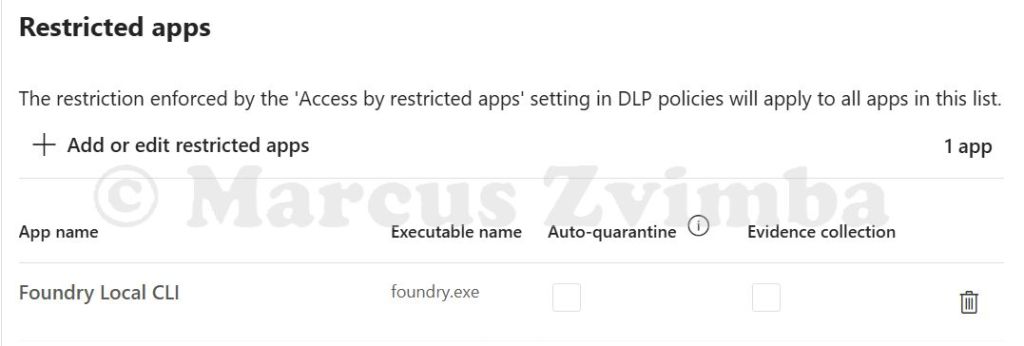
Ensure the entry is there. The default behaviour for restricted apps (unless overridden by policy) is to audit. We will enforce the block via policy next. The settings page will look like this:

Now Purview knows about the Foundry CLI. Next, we’ll configure the actual DLP policy rule that leverages this.

Step 4: Create a DLP Policy to Block Restricted App Access

We’ll create a custom DLP policy that targets our sensitive info and blocks any restricted app (like foundry.exe) from accessing it. Here’s how:

  • In the Purview portal, go to Data Loss Prevention > Policies > Create Policy > Data stored in connected sources.
  • Choose Custom policy. Name it something like “Block Sensitive Data to Foundry Local AI”.
  • On Assign admin units select Next.
  • On Locations: Tick Devices (we want this on endpoints), and untick all the other options.
  • To the right of the ticked Devices > Edit the scope, IMPORTANT: Only apply this to your test groups
  • Name the rule “Sensitive content” and add conditions.:
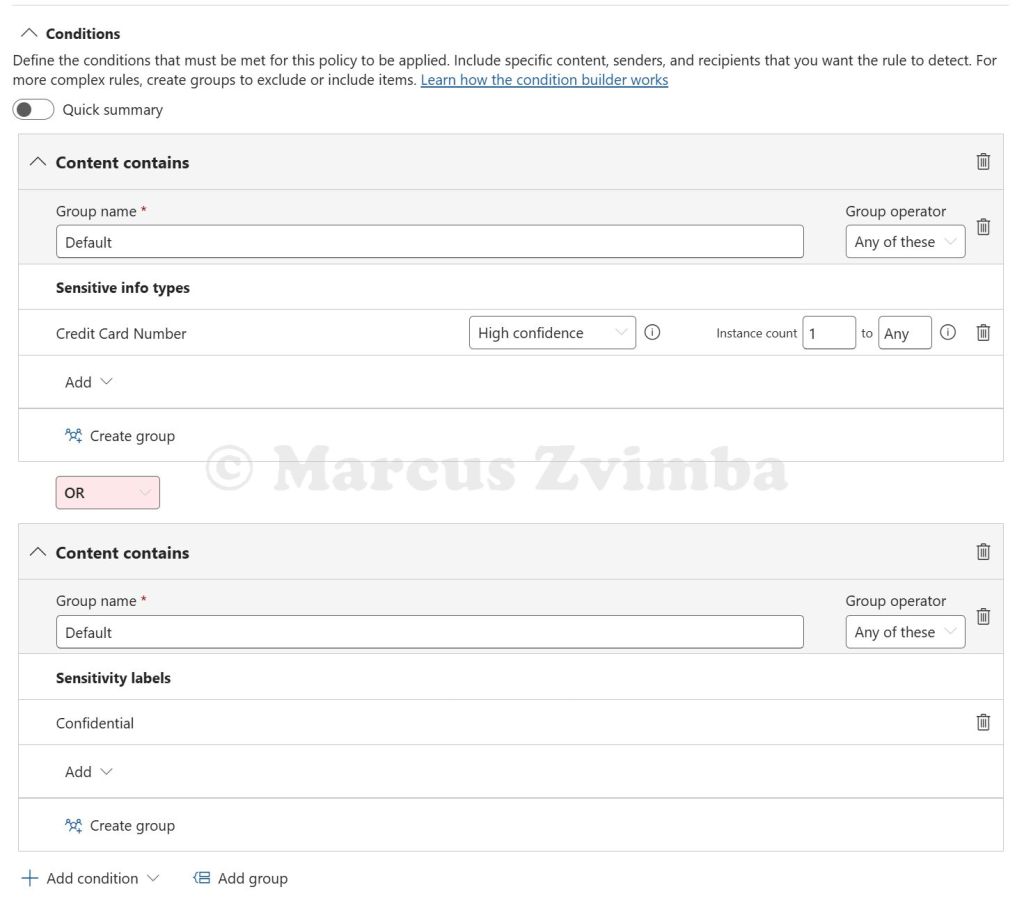
    • Click Add condition > Sensitive info types. Pick “Credit Card Number” and set it to at least 1 instance. (Our file has one, so that’ll hit.) You could also add “UK National Insurance Number” or whatever fits your content. Each added type is an OR by default (any one matching triggers the rule).
    • Additionally, add Sensitivity label as a condition. Select the label Confidential. Now the rule will trigger if the file has that label OR matches an SIT. You can have multiple conditions; by default it’s “Any condition matches”.
    • Tip: If using multiple, ensure to group accordingly if needed. In our case, Credit Card OR Confidential label is fine.
  • Scroll to Actions > Select Audit or restrict activities on devices.
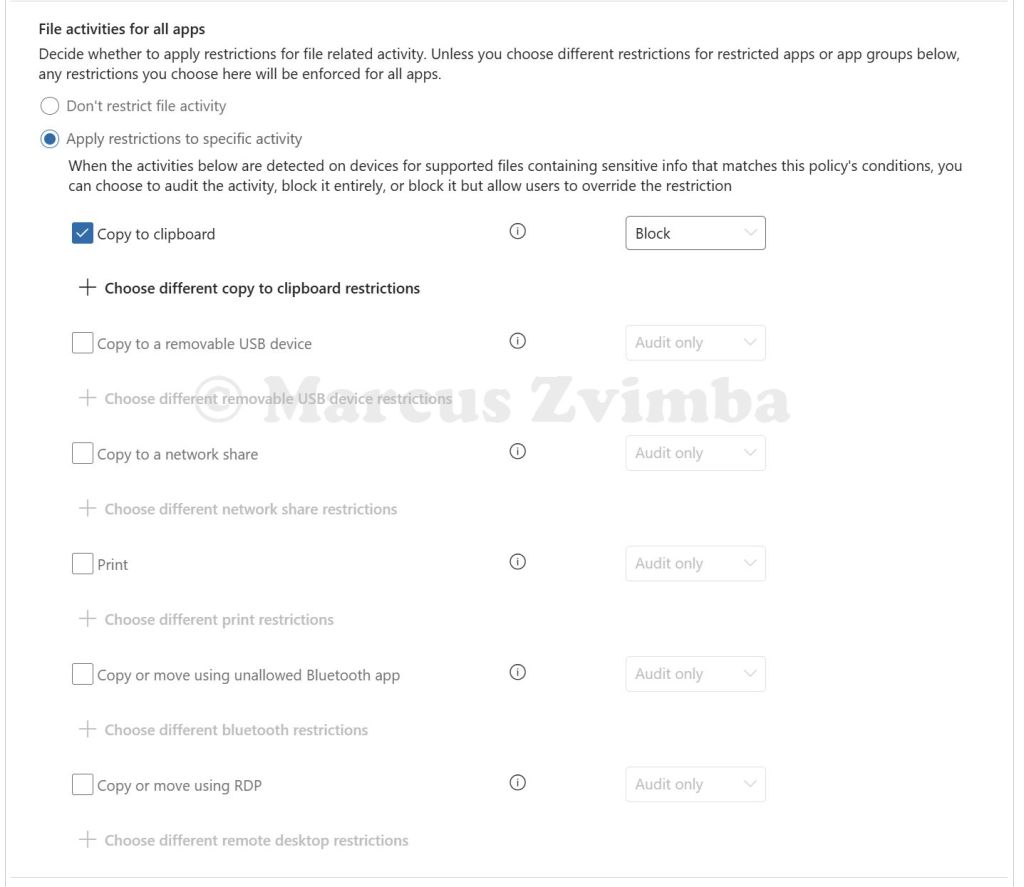
  • set File activities for all apps to Apply restrictions to a specific activity
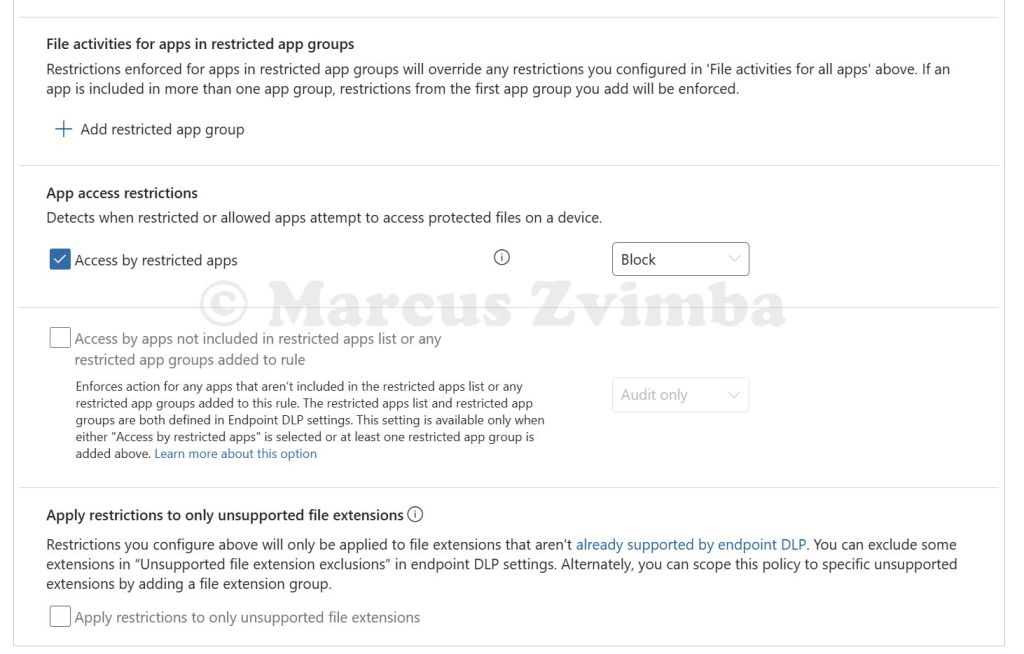
  • Select Copy to clipboard > Block. Untick all the other options. I’ll explain why we need this later in the post.
  • Under App access restrictions > Tick Access by restricted apps > Select Block. This corresponds to any app we put in the restricted list trying to open the file.
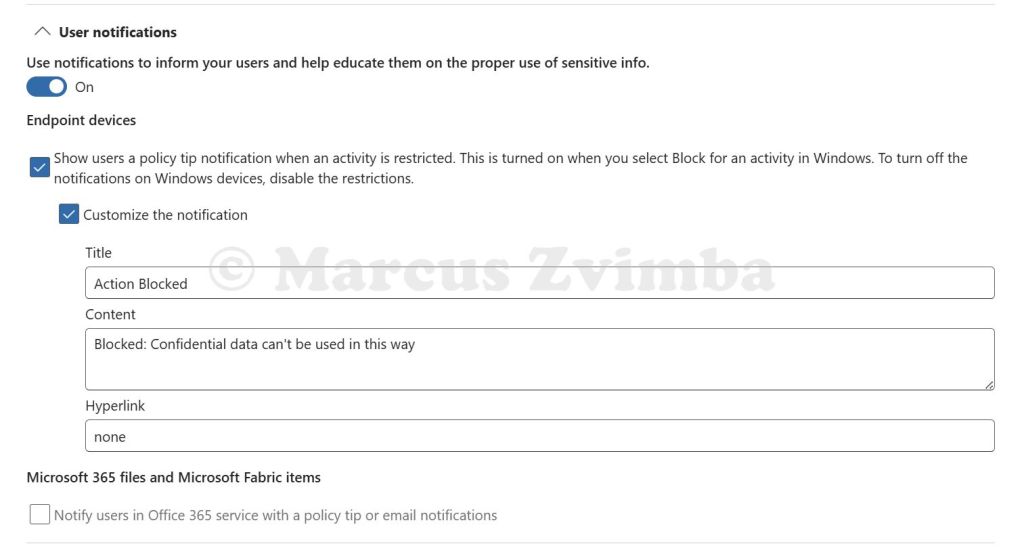
  • Toggle “User notificationson for endpoint. This ensures the user sees a popup when the policy triggers. You can customise the message if you like (“Blocked: confidential data can’t be used with this app”) but it’s optional.
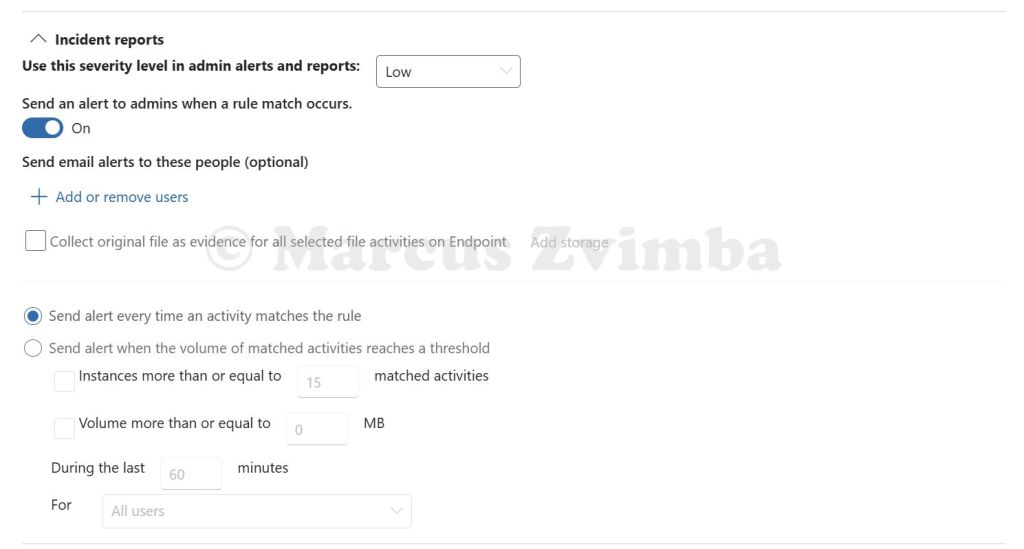
  • For the lab, I toggled on Alerting for this rule. This way, when it triggers, an alert is generated in Purview (useful to demonstrate logging). Set it to alert every time or just the first time – up to you.
  • Choose Turn the policy on immediately (not simulation mode) since we want the block to actually happen now. Click Submit and let it publish.
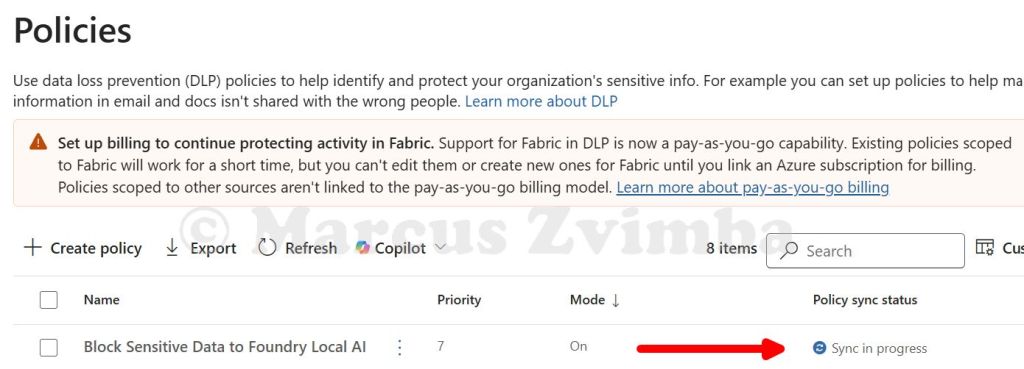
It can take a long time for policy changes to take effect, anywhere from 1 to 24 hours. The DLP agent on the device will download the new policy in the background. So, time for a break!
Step 5: Run Foundry Local CLI and Attempt to Access the File

Time for the fun part – will our AI model be thwarted by DLP? Let’s simulate a user (us) trying to feed the sensitive file into the local AI model:

  • Install Foundry Local on the Windows device by running the below command
winget install Microsoft.FoundryLocal
  • Open Command Prompt (as the regular user, not admin). Start a model by running a command:
foundry model run phi-4-mini

This tells Foundry Local to run a small instruction-following model (phi-4-mini). It will download the model if not already cached, then start an interactive session

You’ll see some logs of model loading, then a prompt like Foundry > indicating it’s ready for input.
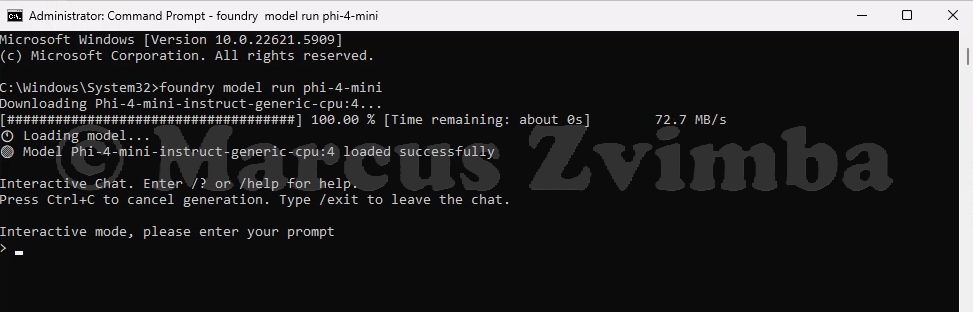
Press Ctrl + C to exit the foundry prompt

Now we will test our DLP policy:

  • Test A: Redirect the unlabelled file into Foundry: Type the command (replacing the file location with your file’s location):
foundry model run phi-4-mini < "C:\Users\AlexWilber\OneDrive - Contoso\Documents\SensitiveData.txt"

This uses shell redirection to pass the file content as input to the model.

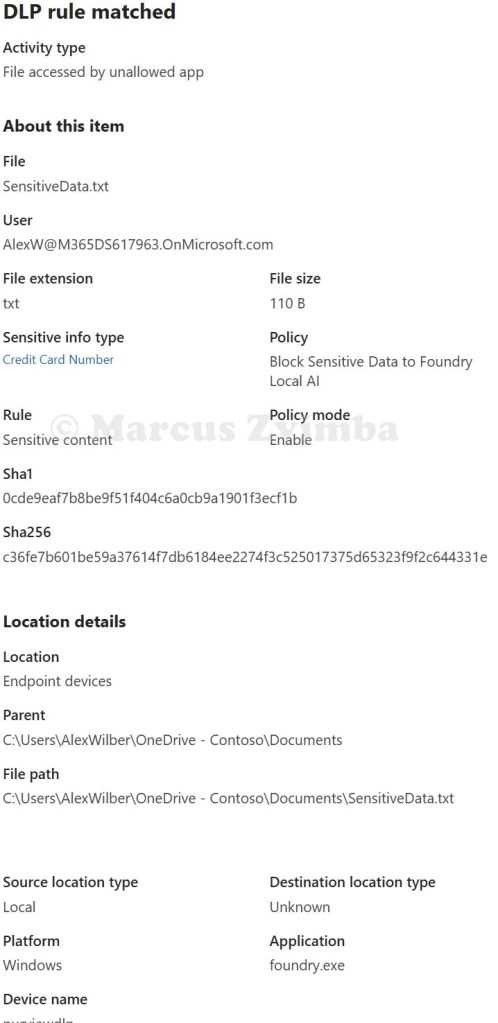
  • Result – Blocked! The command line reported that Access to the file is blocked. I immediately got a Windows notification in the bottom-right: “Blocked: Confidential data can’t be used in this way”. Bingo! The foundry.exe process was prevented from reading SensitiveData.txt.
  • In the Purview portal > Solutions > Data Loss Prevention > Explorers > Activity Explorer > Search for an activity called ‘DLP rule matched‘. Open the match for your device and the file you tried to access. Below are the details for this blocked action

Test B: Redirect the labelled file into Foundry: Type the command (replacing the file location with your file’s location):

foundry model run phi-4-mini < "C:\Users\AlexWilber\OneDrive - Contoso\Documents\SensitiveReport.docx"

This uses shell redirection to pass the file content as input to the model.

  • Result – Blocked!  The command line reported that Access to the file is blocked I immediately got a Windows notification in the bottom-right: “Blocked: Confidential data can’t be used in this way”. The foundry.exe process was prevented from reading SensitiveReport.docx.
  • In the Purview portal > Solutions > Data Loss Prevention > Explorers > Activity Explorer > Search for an activity called ‘DLP rule matched‘. Open the match for your device and the file you tried to access. Below are the details for this blocked action

Test C: Copy/Paste: We know that foundry.exe cannot read the files directly. But what if your user wanted to copy and paste the sensitive content in to the AI model’s prompt? To prevent this we have used a sledgehammer. Due to a limitation of Purview Endpoint DLP, there is no Purview option to Block pasting data into foundry.exe when it is accessed via the command line. We must block the data being copied into the clipboard in the first place.

Suppose we had a local application that uses a local AI model under the hood, like a chat bot. That app is accessed via a web front end using Edge browser. We could set our DLP policy to block 'Paste to supported browsers' so that we don't have to completely block the ability to Copy the data to the clipboard.

Remember in our DLP policy we blocked Copy for all apps? Well, this is the sledgehammer! No application on this device will be able to copy our sensitive data in to the clipboard (the Credit card number from the unlabelled text file or data from the labelled Word document).

To test this, we open SenstiveData.txt and try to copy the Credit Card number. It is blocked.

We try the same with any data in SenstiveReport.docx and it is also blocked.
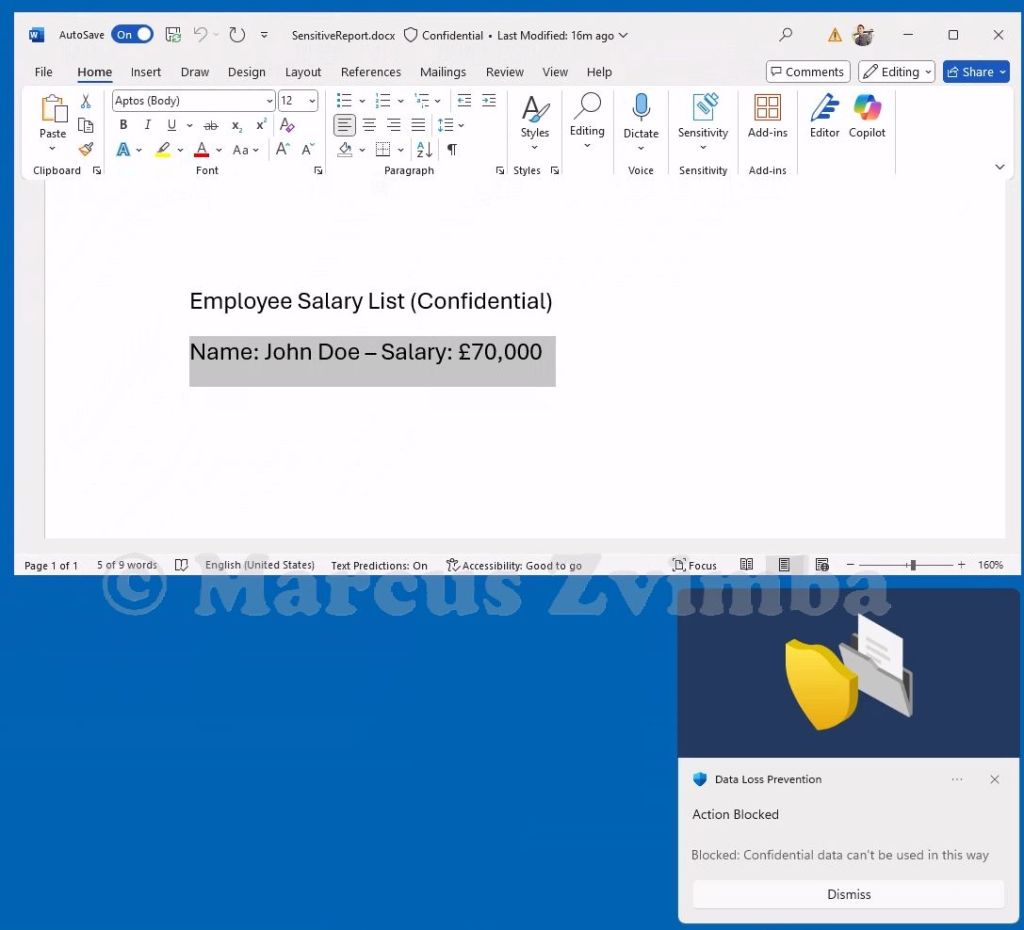
This is indeed a sledgehammer as it impacts how the user can work with data that they may have a legitimate need to copy and paste into different applications. Instead, you could use a Block with override policy setting that allows the user to proceed with the Copy after they have been warned not to use it with the local AI model.

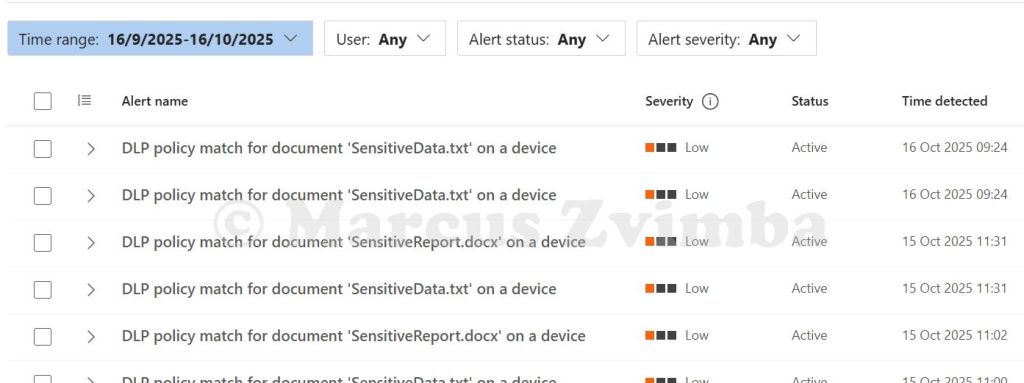
Lastly, go to Purview portal > Solutions > Data Loss Prevention > Alerts. Here we see the Low priority alerts we configured to trigger in the DLP policy.

Additional Notes and Observations

  • Foundry Local CLI specifics: Currently, Foundry’s model run command doesn’t have a built-in “open file” parameter (it’s geared for interactive chat2). We simulated file input via shell redirection.
  • Scope of policy: We applied the policy to all devices/users for simplicity. In production, you could scope it to specific users or device groups. For instance, maybe only apply to users in a particular department initially, or exclude certain test machines.
  • Audit vs Block: We went straight to blocking to demonstrate the feature. A best practice is to start with Audit mode to see how often an event would trigger. If you had run our policy in Audit, then Foundry would have received the data but the event would still be logged as “Access by restricted app (Audit)”. After confidence, you flip to Block. For a lab/demo, Block is more dramatic to show 😃.
  • Limitations: This solution prevents direct file access or copying. It doesn’t cover a scenario where a user might manually re-type info or if they took a screenshot and fed that to an AI (that’s a different vector – though Purview can also block screen captures of labelled content if you disable the Copy permissions in Access Controls in the sensitivity label).
    The policy does not differentiate which model is running – it blocks the Foundry CLI entirely from those files. In some orgs, you might eventually allow certain vetted models but not others; currently, the control is at the app level rather than model granularity.

Conclusion

We successfully showed that Microsoft Purview Endpoint DLP can safeguard sensitive files from being processed by a local AI model. By configuring foundry.exe as a restricted app and creating a DLP policy to block its access to classified data, the system prevented the data from ever leaving its file – the AI got nothing.

This lab mirrors real-world concerns: employees might be tempted to use powerful local AI tools (like Foundry, chat bot clients, etc.) with work data. With proper DLP controls, you can permit the benefits of AI while mitigating the risks of unauthorised use of AI with sensitive information.

If blocking is not your priority but monitoring is, then you can leverage Endpoint DLP in Audit mode which feeds alerts to the Purview portal. Then use Purview Insider Risk Management policies to detect risky behaviour, such as an application that uses local AI opening many documents that contain sensitive information when that is not normal for how the AI model was intended to be used.

Happy labbing, and stay secure while you innovate!

M365 Copilot & Your Data: 4 Common Misconceptions

Since Microsoft 365 Copilot landed, I’ve had many conversations with businesses who are anywhere from just starting on their journey with it to being advanced users. I have listed here some common misconceptions I hear about data and M365 Copilot. Most of them boil down to one thing, misunderstanding what Copilot actually is and how it works under the bonnet.

In this post I talk about the paid license M365 Copilot that is typically used by businesses, not the free, personal Microsoft Copilot.

So let’s clear the air. Here are four common misconceptions I’ve heard, and the real story behind each one.


Misconception 1: “When I buy Copilot, I get my own private AI model”

Nope, that’s not how it works.

When you license Copilot, you’re not spinning up your own personal GPT instance tucked away in a private server. What you’re actually getting is secure access to a shared large language model hosted in Microsoft’s cloud. Think of it like renting a lane on a motorway, you’re using the same infrastructure as everyone else, but your data stays in your own vehicle.

Microsoft’s architecture is designed to keep your data isolated. Your prompts and context are processed securely, and your content is never used to train the model. So while the model is shared, your data isn’t.


Misconception 2: “My data never leaves my tenant”

This one’s a bit trickier. Your data does reside in your tenant, but when you use Copilot, the relevant bits of it are sent to Microsoft’s cloud-based AI models for processing.

That means your prompt and the context Copilot gathers, emails, files, chats and so on, are securely transmitted to the nearest available AI compute cluster. If that cluster’s busy, your data might be routed to another Microsoft datacentre, possibly in another country. But if you’re in the EU, Microsoft guarantees that your data won’t leave the EU boundary.

So yes, your data leaves your tenant, but it stays within Microsoft’s secure cloud, and within the rules.


Misconception 3: “Copilot can access all ‘Anyone’ share links in my organisation”

Not quite.

An ‘Anyone’ link, the kind that lets anyone with the link view a file, doesn’t automatically make that file searchable. For Copilot to surface content from an ‘Anyone’ link, the user must have redeemed the link, meaning they’ve clicked it and accessed the file.

Until that happens, Copilot treats the file as off-limits. It operates strictly within the context of the user’s permissions. So if you haven’t clicked the link, Copilot won’t see it, even if the link exists somewhere in your tenant.

Also worth noting, ‘Anyone’ links are risky. They’re essentially unauthenticated access tokens. Anyone can forward them, and there’s no audit trail. Use them sparingly.


Misconception 4: “Copilot only sees my data if I attach it to the prompt”

Wrong again.

Copilot doesn’t wait for you to upload a document or paste in a paragraph. It automatically pulls in any content you already have access to, emails, OneDrive files, SharePoint docs, Teams chats, calendar entries, the lot.

This is called grounding. When you ask Copilot a question, it searches your Microsoft 365 environment for relevant context, then sends that along with your prompt to the AI model. If you’ve got access to a file that answers your question, Copilot will find it, no need to attach anything manually.

That’s why data access controls are so important. If a user has access to sensitive content, Copilot can use that content in its responses. It won’t override permissions, but it will amplify whatever the user can already see.


Final Thoughts

M365 Copilot is powerful, but it’s not magic. It works within the boundaries of Microsoft 365’s architecture, permissions and security model. Understanding those boundaries is key to using it safely and effectively.

If you’re rolling out Copilot in your organisation, make sure your users understand what it can and can’t do and make sure you know how to protect your data.


Further Reading

How to Disable Windows Copilot using Intune or Group Policy

In this post I will explain how to use Microsoft Intune or Active Directory Group Policy to disable Windows Copilot for one or more users.

Introduction

On 26th September 2023, Microsoft released optional update KB5030310, one of the most ground breaking updates to Windows in recent times. With it comes Windows Copilot, which for millions of users worldwide will serve as an introduction to using an AI powered chat interface to enhance their day to day productivity.

Many organisations are still adjusting to the march to an AI enabled workplace and so need some time to test and understand before unleashing it for their workforce.

Disable with Intune

Edit: 23/10/2024 - in May 2024 Microsoft have deprecated the TurnoffWindowsCopilot policy CSP that is referenced in the steps below. This means the Intune steps in this post will not work. See Microsoft's post on the subject:  https://techcommunity.microsoft.com/t5/windows-it-pro-blog/evolving-copilot-in-windows-for-your-workforce/ba-p/4141999

A recent addition to the Policy CSP is the TurnOffWindowsCopilot setting, documented here. At the time of publishing this post there is no built-in setting in Intune to manage Windows Copilot. So we will create a custom OMA-URI policy:

  • In Intune, select Devices > Windows > Configuration Profiles > Create profile.
  • Under Platform select Windows 10 and later.
  • Under Profile type select Templates.
  • Under Template Name select Custom > select Create.
  • Name the profile something meaningful.
  • Under Configuration Settings select Add.
  • Set the name to something meaningful.
  • Under OMA-URI enter the below text:
./User/Vendor/MSFT/Policy/Config/WindowsAI/TurnOffWindowsCopilot
  • Set Data type to Integer.
  • Set the Value to 1 (setting it to 0 will enable Windows Copilot which is the default setting).
  • Save the policy and assign it to a security group containing users for whom you wish to disable Windows Copilot.
  • No reboot is required. When the user next signs in, the Windows Copilot icon in the taskbar will have been removed.
The Administrative Template that is used in the Group Policy version below cannot be imported in to Intune as a Custom Administrative Template. When you come to apply it to a device it will fail because it tries to modify a protected part of the registry.

Disable with Group Policy

Pre-Requisites

  • Obtain the WindowsCopilot.admx and WindowsCopilot.adml files from the C:\Windows\PolicyDefinitions file of a Windows 11 device that has the KB5030310 installed on it.
    • When Windows 11 23H2 is released it will include the same files.
    • Alternatively, you can download the files from my Github here.

Implement Group Policy

  • Import the WindowsCopilot.admx file to the PolicyDefinitions folder in your domain. This will either be C:\Windows\PolicyDefinitions on your Domain Controllers or if you have a central store configured (which you should do), it will be in a location like:
\\contoso.com\SYSVOL\contoso.com\policies\PolicyDefinitions
  • Import the WindowsCopilot.adml file to the PolicyDefinitions\en-US folder.
  • On a Domain Controller or from a device with the AD DS management tools installed, open Group Policy Management console.
  • Create a new Group Policy Object and name it something meaningful.
  • Edit the GPO, expand User Configuration > Administrative Templates > Windows Components > Windows Copilot
  • Open the setting Turn off Windows Copilot.
  • Set it to Enabled.
  • Select OK. The policy will now look like this:
  • Link the GPO to an Organisational Unit that contains users for whom you wish to disable Windows Copilot.
  • No reboot is required. When the user next signs in, the Windows Copilot icon in the taskbar will have been removed.

Summary

Windows Copilot provides an opportunity for users to begin experimenting with a new way to command their computers. In a production environment, it is important to use deployment rings such as Test, Pilot and Broad to prepare for and understand the impact of any change to the environment. An ability to roll back for individual users is most welcome. Fortunately, Microsoft have made it easy to switch Windows Copilot on and off on a targeted basis.

Preparing for Microsoft Copilot

💡 What are some of the things you can do NOW to start preparing for Microsoft Copilot in your organisation?

✅ Understand that there is technical readiness and people readiness. Both need attention to maximise return on investment.

✅ Familiarise yourself with Copilot and its role in the world of generative AI https://www.microsoft.com/en-us/ai.

✅ Engage your Ethics, Legal, and Inclusion champions early on to address the implications of generative AI.

✅ Incorporate the six Microsoft principles in AI into your company’s AI usage policy https://www.microsoft.com/en-us/ai/responsible-ai.

✅ Take your first step into the Copilot world with Bing Chat Enterprise https://www.microsoft.com/en-us/bing/chat/enterprise/?form=MA13FV, an AI-powered chat platform included with common M365 licences

✅ Prioritise data security by reviewing identity and access policies, using data labelling for sensitive documents, and ensuring awareness of file sharing risks. Do your device management policies need a health check?

✅ Identify areas where you may need external assistance and initiate conversations with technology partners.

🚀 Implementing generative AI into a business is a marathon, not a sprint. Set those expectations now. There are quick wins out there to get hands on with the technology while you get Org ready.  Windows Copilot in Windows 11 is one of them Hands on with Windows Copilot.

Hands on with Windows Copilot

In this post, I explain my first impressions of Windows Copilot along with some tips for getting started with it.

Introduction

On 26th September 2023, Microsoft released optional update KB5030310, one of the most ground breaking updates to Windows in recent times. With it comes Windows Copilot, which for millions of users worldwide will serve as an introduction to using an AI powered chat interface to enhance their day to day productivity.

Installing Windows Copilot Preview

Check out my guide for installing the Windows Copilot Preview.

Accessing Windows Copilot

Once installed, the Windows Copilot Preview icon appears in the taskbar.

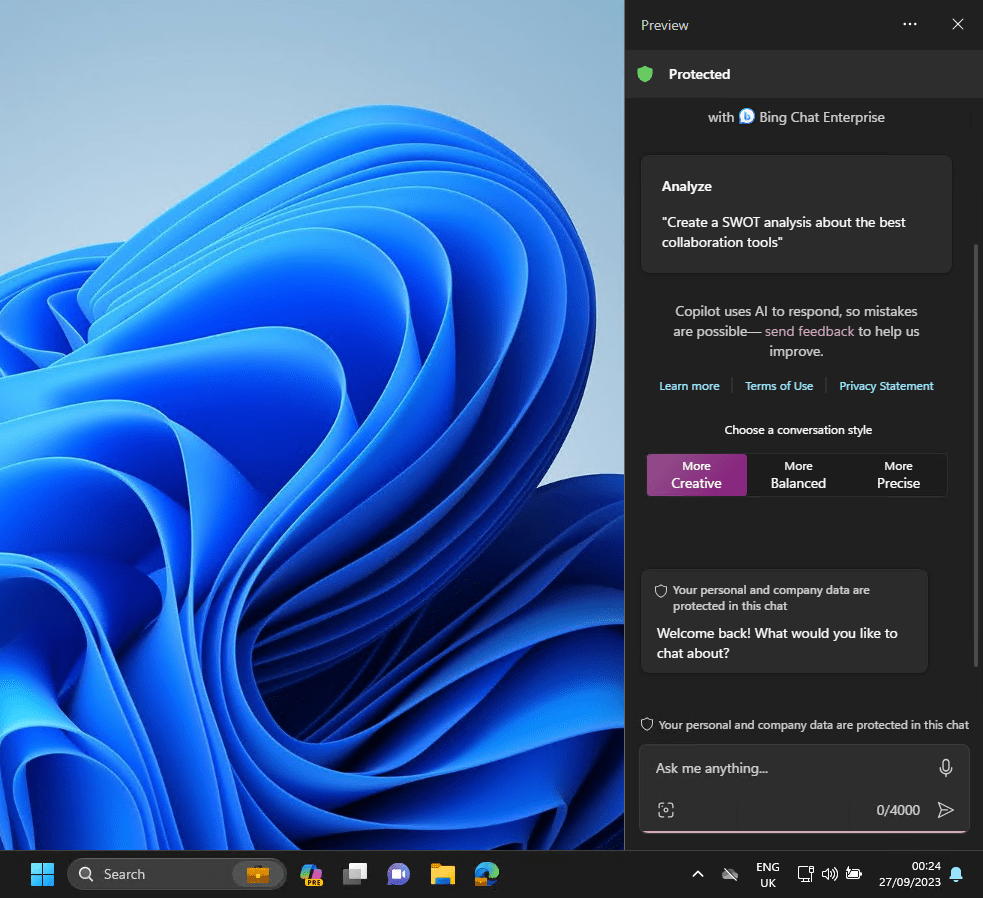
Clicking the Copilot icon opens the full vertical length chat interface.

The screenshot above was taken while logged in on an Azure AD joined device that had Bing Chat Enterprise enabled. This is what the Protected green shield at the top signifies. 

Changing Device Settings

Frist things first. Settings in Windows are buried all over the place. Copilot helps by you simply telling it what you want to do. Copilot will respond with a question with Yes and No thanks buttons. In the video below, I ask it to set Windows to the light theme.

Compound Task

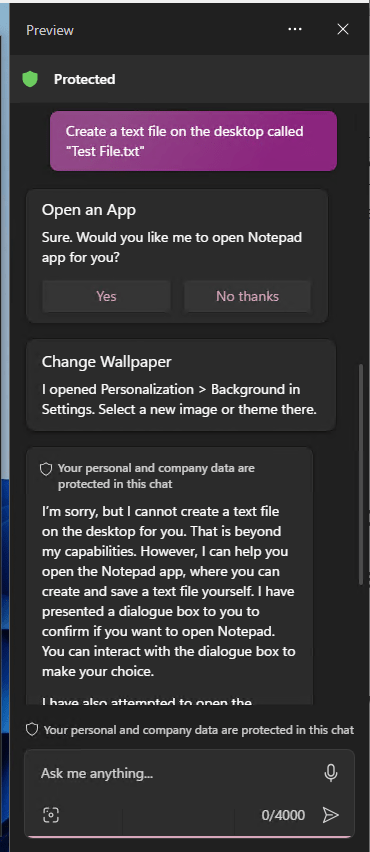
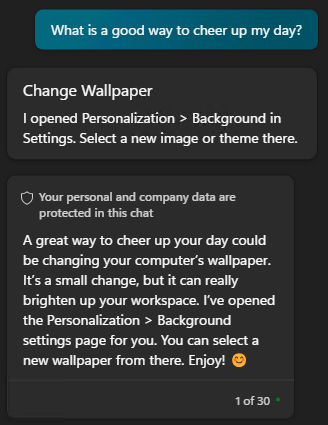
Trying something more advanced, I asked it to create a text file on the desktop. It offered to open Notepad for me and apologised for not being able to perform the end to end task itself. It also opened the Desktop Background settings window in case I wanted to change the theme.

Getting advice for troubleshooting

Telling Copilot that my workstation was slow it presented me with a couple of options to get started. First were Yes/No questions for opening Task Manager or opening ‘a troubleshooter’. It followed that with some guidance text.

A bit of a fail though was that clicking ‘open a troubleshooter’ failed saying that the Get Help app wasn’t installed!

Summarising a Web Page

Let’s get to the really clever stuff. Windows Copilot integrates with Bing Chat (Bing Chat Enterprise if its enabled in your Azure tenant). This brings some cool features. In the video below I am browsing the United States Constitution, a large document. Copilot summarises this in a concise manner.

  • I found that asking it to summarise the Wikipedia page of The River Thames or the recent amendments to an IEEE standard resulted in it largely regurgitating verbatim what was on the web page.
  • I think this feature will work best when not attempting to summarise highly technical documents (the IEEE standard) or indeed, text that is already very concise like the Wikipedia page.
  • Simply typing summarise this page sometimes did not trigger the Edge integration, instead it described what the Copilot window was for. Typing summarise this web page seemed to always work.

The first time you try to use the Copilot > Edge integration, you will need to give permission to share Edge browser content with Copilot when it prompts you.

Integration with Bing Search

We have had search bars in Windows for many years. Copilot however binds the advanced understanding that AI can bring. Here I asked it to provide an outline for a 15 minute presentation about ant nesting habits and to include reference articles. It provided links to sources for the facts in the presentation. A small section is below:

Images and Snipping Tool

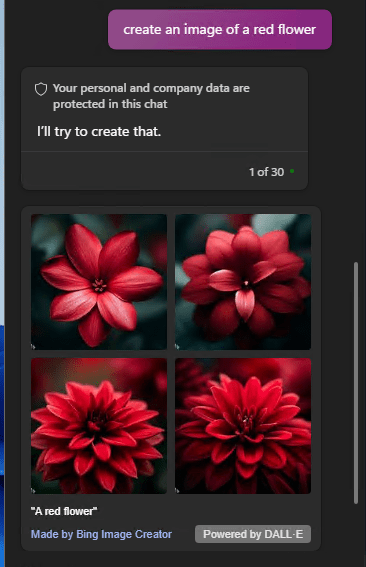
Bing’s AI image creation service, powered by DALL-E, is accessible via Copilot. Just ask it to create any image and off it goes.

When you use the Snipping Tool, Copilot will ask if you want to add the image to the chat. You can ask Copilot about the image.

Choosing Conversation Style

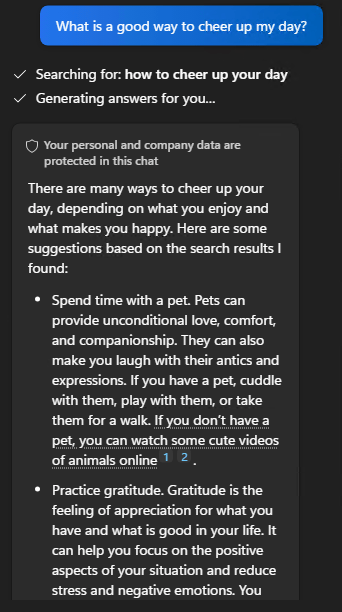
You have probably realised by now that Copilot is quite wordy. It defaults to a conversational style which will help many users who are new to Copilot. When you want to get to the point though, you can change from More Creative (purple) to More Balanced (blue) or More Precise (teal).

Below is an example of how this affects the responses. As you can see, if you’re looking for a warm, cuddly bit of chat, don’t turn to More Precise!

Conclusion

Windows Copilot presents the second evolution of Microsoft’s generative AI offering. The first being Bing Chat and the next being Microsoft Copilot. If you are preparing your organisation for Microsoft Copilot, enabling Windows Copilot is a great way to start training users in a new way to command and converse with their computer.

Windows Copilot is useable and versatile even at this early stage in its life. It will develop, for instance there are more integrations with built-in Windows apps that will are slated for phased rollouts soon.

How to Get Windows Copilot Preview

In this post I will describe how to install the Windows Copilot Preview update.

Introduction

On 26th September 2023, Microsoft released optional update KB5030310, one of the most ground breaking updates to Windows in recent times. With it comes Windows Copilot, which for millions of users worldwide will serve as an introduction to using an AI powered chat interface to enhance their day to day productivity.

Now lets walk through how you can get your hands on it.

Prerequisites

  • A device running Windows 11 22H2.
  • An environment that allows you to manage your Windows Update settings (some corporate networks prevent users from doing this by restrictive policies).

Installing Windows Copilot Preview

The process requires a reboot
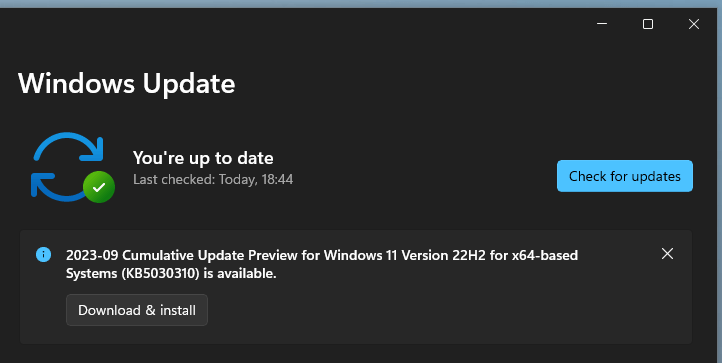
  • From the Desktop select Start > Settings > Windows Update.
  • Turn on Get the latest updates as soon as they’re available.
Enabling preview features may reveal additional features unrelated to Windows Copilot. I recommend only doing this on test devices.
  • Select Check for Updates.
  • The update “2023-09 Cumulative Update Preview for Windows 11 Version 22H2 for x64-based Systems (KB5030310)” will appear.
It is possible to install the update without enabling Get the latest updates as soon as they're available however, Windows Copilot will be hidden.
  • If you don’t see the update, try selecting Advanced options > Optional updates.
  • Install the update.
  • Reboot the device.
  • Login and wait for the Desktop to load. You will now see the Copilot Preview icon
  • Select the icon and you will be presented with Windows Copilot! Enjoy!

The screenshot above was taken while logged in on an Azure AD joined device that had Bing Chat Enterprise enabled. This is what the Protected green shield at the top signifies. 

Summary

Welcome to a new way of commanding your device. As you can see, it is easy to install the preview. When Windows 11 23H2 is released in Q4 2023, Windows Copilot will be enabled by default. Check out Microsoft’s 2 minute video overview of features in this update:

Universal Print with Intune Settings Catalog and upprinterinstaller.exe popups

In 2022, Microsoft added the Universal Print policy CSP to the Intune settings catalog. This replaced the Universal Print Printer Provisioning Tool and brought about a significant time saving when configuring Universal Print deployment policies.

When the Intune policy is sync’d with a device and a user logs in, the upprinterinstaller.exe runs to set up the printer for the user. Unfortunately, this does not run silently, instead displaying a popup for the user as pictured below:

My testing showed that this occurs on both Windows 10 and Windows 11 (edit 31st July 2024: Microsoft say they have fixed this in Windows 11 but I have not tested this since then). Each printer you deploy gets its own individual popup. So if you are deploying lots of printers, expect to see lots of popups. Combining multiple printers in to a single policy did not reduce the number of popups.

They stay on the screen for between 2 to 20 seconds depending on the device’s resource load. I’ve found that when I’ve misconfigured the deployment settings, the popup stays for up to a minute before exiting (presumably timing out).

In all instances, no user interaction is required. It always closes itself and no messages are displayed on the popup other than the .exe name.

Back in November, Microsoft acknowledged this popup as an issue they are investigating but have not provided any further update. It still does not feature on the Universal Print known issues list.

How-to: Desktop Analytics – Export list of devices a given Application or Driver is installed on

Desktop Analytics is now available in Public Preview - Microsoft Tech  Community

Introduction

Desktop Analytics is a powerful tool for helping plan deployments of Windows 10 Feature Updates. Two of its features are the Apps and Drivers tabs which provides cloud enabled insights in to your Application and Driver estate and its compatibility with Windows 10 Feature Updates.

The Apps tab has a Plan Installs column which tells you how many devices the particular Application is installed on. Similarly, the Drivers tab has a Plan Devices column which does the same.

One of the shortcomings of the Desktop Analytics console is that although it tells you how many devices have an Application or Driver , you cannot drill down further to get a list of those devices. Being able to view the list of devices without having to run a report in ConfigMgr is a challenge that I recently encountered.

In steps Log Analytics workspace queries! Desktop Analytics stores its data in a Log Analytics workspace. Using the query language Kusto (KQL) we can search the database directly and export lists of devices. Below I have shared the scripts I wrote to do this along with explanations of what they are doing.

Skip to the end of this post if you just want to see the scripts in their entirety.

Pre-requisites

  • Ability to run queries in the Log Analytics workspace in which Desktop Analytics resides.
  • Access to the Desktop Analytics console.

Prepare

1. Get the exact wording for the search terms

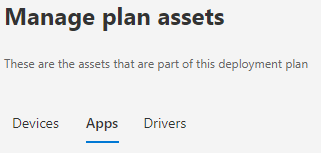
First go to the Desktop Analytics console and drill down in to your Deployment Plan > Plan assets > Apps.

Select the Application that you want to report on from the list. In this example I want Adobe Acrobat Reader DC version 21.001.20145.

Copy the exact wording of the name and version number. We will use this in the script query.

If you are searching for a Driver then you go to Deployment Plan > Plan assets > Drivers.

Select the Driver that you want to report on from the list. In this example I want the HP HD Camera Driver spuvcbv64.sys version 3.7.8.5.

Again, ensure to copy the exact wording of the name and version number.

2. Open a Log Analytics workspace query

Navigate to the Log Analytics workspace that contains the Desktop Analytics data. On the left hand menu select Logs.

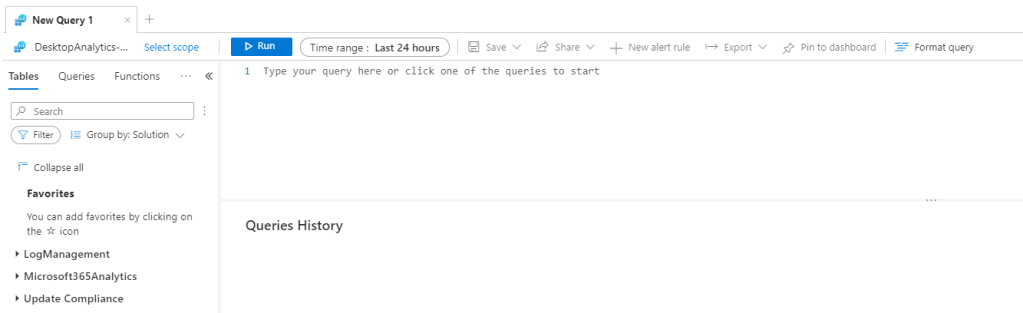
You should see a blank New Query 1 window (you may have to close the Queries popup to see this).

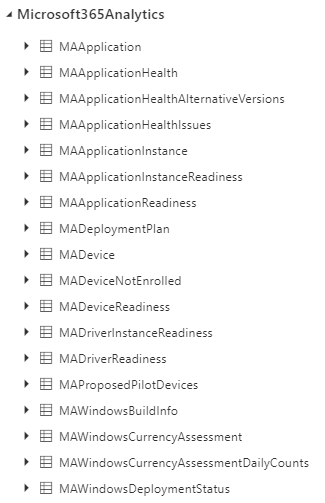
The scripts use tables in the Microsoft365Analytics sphere. If you expand this on the left you will see all the available tables.

Tip: Double clicking a table will add it to the query pane. Select Run with just the name of a table in the query pane and you will see all the data in the table.

Scripts Deep Dive

Tip: Desktop Analytics takes a data scrape from Microsoft’s central Telemetry repository once every 24 hours. The historical data is left in the tables. So when searching a table be sure to filter by the last 24 hours to prevent duplication of results!

Applications

There are three sections to this code that deal with each table it needs to work through to find the device names from a given Application name.

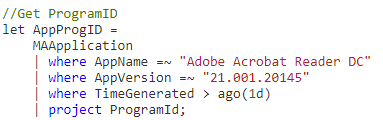
Part 1

Creates a variable named AppProgID.

Searches the MAApplication table for the Application name and version number. Filter on the most recent data scrape (last day) and extract only the unique ProgramID. There is one ProgramID per Application/Version pairing so each version of Adobe Acrobat Reader DC has its own unique ProgramID.

Tip: You can leave the AppVersion field empty if you are searching for an Application that Desktop Analytics has not detected the version of. You will encounter these In the DA console, the version field is blank.

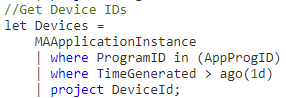
Part 2

Another variable is created called Devices. Searches the ProgramID column of the MAApplicationInstance table for entries matching the ProgramID stored in the AppProgID variable.

Filters for the most recent data scrape (last day) and extracts the unique device ID. These IDs are meaningless outside of Desktop Analytics so we need to convert these to the device names.

Search the DeviceID column in the MADevice table for anything matching entries in the Devices variable. Filters for the most recent data scrape (last day) and extracts a useful set of information about the devices.

You can export this list to CSV by clicking Export at the top of the Query pane.

Drivers

Due to a difference in the way the data is stored in the tables there are only two parts to this script.

Part 1

Creates a variable named DeviceID.

Searches the MADriverInstanceReadiness table for the Driver name and version number. Filters on the most recent data scrape (last day) and extracts only the unique DeviceID of all devices that have the Driver installed.

Tip: You can leave the DriverVersion field empty if you are searching for a Driver that Desktop Analytics has not detected the version of. You will encounter these in the DA console, the version field is blank.

Search the DeviceID column in the MADevice table for anything matching entries in the DeviceID variable. Filters for the most recent data scrape (last day) and extracts a useful set of information about the devices.

You can export this list to CSV by clicking Export at the top of the Query pane.

Scripts In Full

Applications

// Desktop Analytics: List workstations with a particular
// Application installed.
// Author: Marcus Zvimba, 28th April 2021
//
/////// INSTRUCTIONS
// Replace the text in the speech marks after AppName and AppVersion with the name and
// version of the Application as it appears in the Desktop Analytics console.
// The text is not case sensitive.
//

//Get ProgramID
let AppProgID =
    MAApplication
    | where AppName =~ "Adobe Acrobat Reader DC"
    | where AppVersion =~ "21.001.20145"
    | where TimeGenerated > ago(1d)
    | project ProgramId;
//Get Device IDs
let Devices =
    MAApplicationInstance
    | where ProgramID in (AppProgID)
    | where TimeGenerated > ago(1d)
    | project DeviceId;
//Get Device Names
MADevice
| where DeviceId in (Devices)
| where TimeGenerated > ago(1d)
| project DeviceName, DeviceId, DeviceLastSeenDate, Manufacturer, Model, OSVersion, OSEdition, OSBuildNumber, OSArchitecture

Drivers

// Desktop Analytics: List workstations with a particular
// driver installed.
// Author: Marcus Zvimba, 28th April 2021
//
/////// INSTRUCTIONS
// Replace the text in the speech marks after DriverName and DriverVersion with the name and
// version of the driver as it appears in the Desktop Analytics console.
// The text is not case sensitive.
//

//Get DeviceID
let DeviceID =
    MADriverInstanceReadiness
    | where DriverName =~ "spuvcbv64.sys"
    | where DriverVersion =~ "3.7.8.5"
    | where TimeGenerated > ago(1d)
    | project DeviceId;
//Get Device Names
MADevice
| where DeviceId in (DeviceID)
| where TimeGenerated > ago(1d)
| project DeviceName, DeviceId, DeviceLastSeenDate, Manufacturer, Model, OSVersion, OSEdition, OSBuildNumber, OSArchitecture

Summary

Kusto is a powerful language and once the core concepts are understood it can be leveraged to maximise the data available from Desktop Analytics. You can create graphical reports to compliment the built-in reports in the Desktop Analytics console.

There is not much movement from Microsoft on the Desktop Analytics UserVoice forum so I highly recommend becoming familiar with how to query the data directly.

Microsoft Local Administrator Password Solution – Part 4 – Auditing

LAPS is a fantastic free tool from Microsoft that manages Domain Member computer local account passwords. https://www.microsoft.com/en-us/download/details.aspx?id=46899

I have deployed LAPS for a number of Enterprise customers to use for managing their Domain Member Windows Server local Administrator account passwords.

In the final part of this blog series we will look at how to audit LAPS password access.

Part 1 of this blog series “Deployment Considerations”

Part 2 of this blog series “Accessing and Resetting Passwords”

Part 3 of this blog series “Monitoring”

Auditing LAPS

LAPS generated passwords are stored on the Active Directory Computer Object in the attribute ms-Mcs-AdmPwd.

By default, when a principal with the AD permission Read ms-Mcs-AdmPwd reads the attribute ms-Mcs-AdmPwd there is no log entry made on the Domain Controller. Therefore, a compromised account could dump all LAPS set passwords from AD undetected.

We can configure auditing within Active Directory. The LAPS Powershell module allows us to easily do this.

In the example below, Auditing is enabled for the Member Servers Organisational Unit.

Import-Module AdmPwd.PS
Set-AdmPwdAuditing -OrgUnit "OU=Member Servers,DC=lab,DC=home" `
-AuditedPrincipals:Everyone
Auditing applied to OU

All Computer Objects in the Member Server OU will now be audited for LAPS password reads.

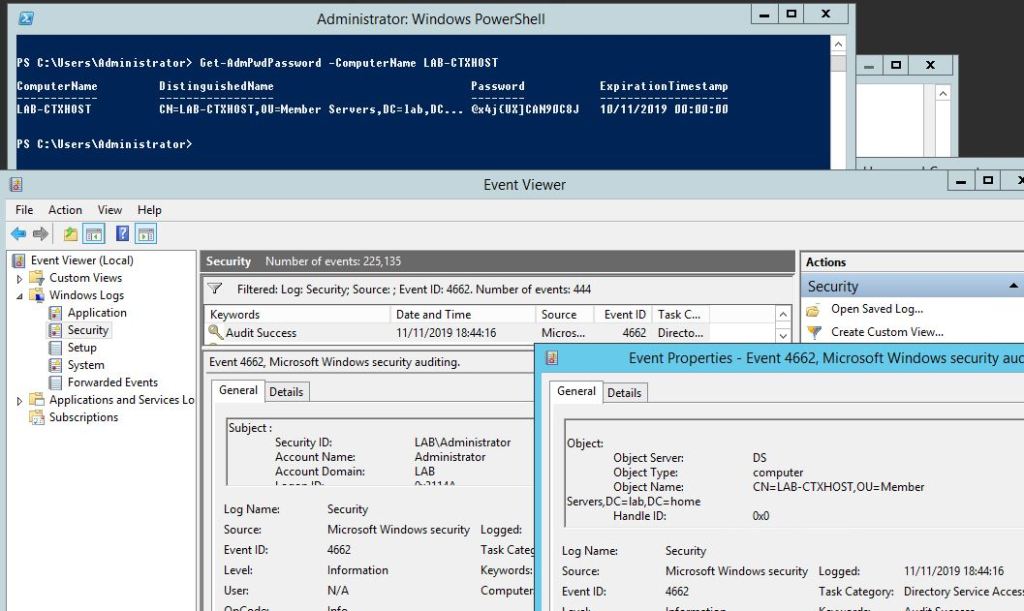
Event ID 4662 is logged in the Domain Controller Security event log every time the password attribute (ms-Mcs-AdmPwd) is read. Which Domain Controller it is logged on depends on which Domain Controller the request is sent to by the client requesting it.

Powershell retrieval of the password triggers event ID 4662 on the Domain Controller

The log entries can be parsed using a combination of the event ID and the schemaIDGUID for the attribute ms-Mcs-AdmPwd (which is unique to each AD Forest).

The three key items in the event are:

  • Security ID (account that read the password)
  • Object Name (Distinguished Name of the computer whose password was read)
  • schemaIDGUID (Identifier for the password attribute)

Finding the SchemaIDGUID

These instructions use a slightly modified version of the answer given by Mathias R Jessen on Stackoverflow.

Run the below Powershell command from a device with the Active Directory Powershell module installed to extract the schemaIDGUID for the attribute ms-Mcs-AdmPwd.

$attrSchemaParams = @{
    SearchBase = (Get-ADRootDSE).schemaNamingContext
    Filter = "ldapDisplayName -eq 'ms-Mcs-AdmPwd' -and objectClass -eq 'attributeSchema'"
    Properties = 'schemaIDGUID'
}
$LAPSschema = Get-ADObject @attrSchemaParams

$LAPSschemaPwdGUID = $LAPSschema.schemaIDGuid -as [guid]
$LAPSschemaPwdGUID
Powershell script output

REMEMBER: This Guid is unique for each AD Forest.

Looking closer at the Event ID 4662 that was logged when we read the password, we can see the same GUID under “Properties:“.

Unique schemaIDGUID

A log monitoring tool can be configured to search for:

  • Targets: Domain Controllers
  • EventID: 4662
  • Keywords: < Unique schemaIDGUID >

Microsoft Local Administrator Password Solution – Part 3 – Monitoring

LAPS is a fantastic free tool from Microsoft that manages Domain Member computer local account passwords. https://www.microsoft.com/en-us/download/details.aspx?id=46899

I have deployed LAPS for a number of Enterprise customers to use for managing their Domain Member Windows Server local Administrator account passwords.

In part 3 of this blog series we will look at how to monitor LAPS operations.

Part 1 of this blog series “Deployment Considerations”

Part 2 of this blog series “Accessing and Resetting Passwords”

Part 4 of this blog series “Auditing”

The LAPS Process

LAPS is a Client Side Extension for Group Policy. LAPS is triggered each time Group Policy is refreshed on a device. This means you will not find it in Windows Services nor running as a process in Task Manager.

When LAPS is triggered, it checks the attribute ms-Mcs-AdmPwdExpirationTime on the host device’s Active Directory Computer Object. If this attribute has no value or is a date and time in the past then LAPS will attempt to set a new password.

First it will attempt to write the password to the attribute ms-Mcs-AdmPwd on the host device’s AD Computer Object. Once it confirms it has been successfully written to AD, LAPS updates the password on the host device (writes the password to the local Security Account Manager database).

  • LAPS will only set a new password if a Domain Controller is accessible after a new password has been generated. This ensures that AD always has the current password.

Monitoring LAPS

LAPS logs to the Application event log with the source AdmPwd. By default, LAPS only logs errors.

The logging level is set by the registry key below:

HKLM\SOFTWARE\Microsoft\Windows NT\CurrentVersion\Winlogon\GPExtensions{D76B9641-3288-4f75-942D-087DE603E3EA}\ExtensionDebugLevel REG_DWORD

ValueMeaning
0Silent mode; log errors only
When no error occurs, no information is logged about CSE activity
This is a default value
1Log errors and warnings
2Verbose mode, log everything

A full list of the possible log entries are in the document LAPS_TechnicalSpecification.docx which is included with the official LAPS download.

Setting the log entries to a value of 1 should suffice for most environments. Your existing monitoring solution may be able to be configured to generate alerts based on the Event Log entries from LAPS.

Logging Demonstration

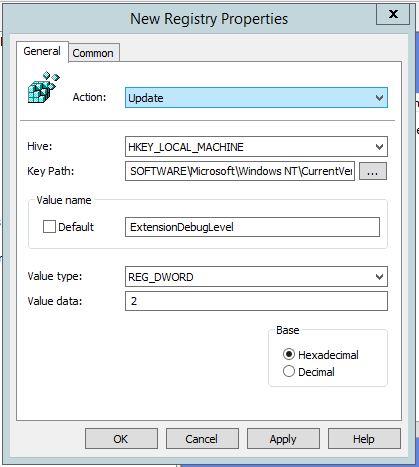
The host LAB-CTXHOST has had LAPS installed. It has a GPO applied that sets LAPS to verbose logging by creating the below registry key:

HKLM\SOFTWARE\Microsoft\Windows NT\CurrentVersion\Winlogon\GPExtensions{D76B9641-3288-4f75-942D-087DE603E3EA}\

ExtensionDebugLevel

Type: REG_DWORD

Value: 2

LAPS Verbose logging

On LAB-CTXHOST using RegEdit we can see that the registry key has been created.

RegEdit

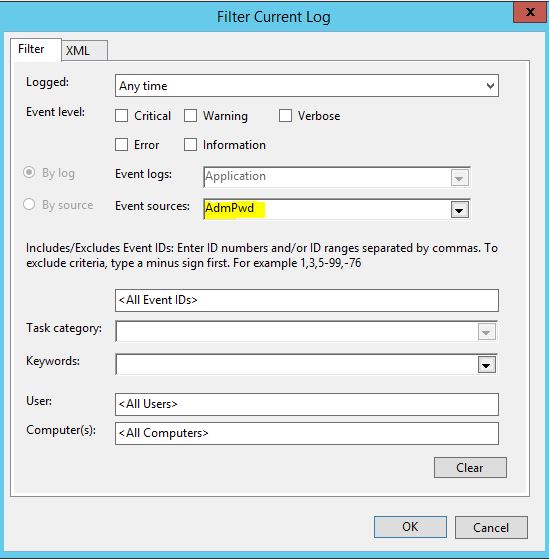
In Windows Event Log, we have filtered the log to only show events from the source AdmPwd.

Application event log filter

Logging Demo: Password Change Not Required

Now we force a Group Policy update by running gpupdate from the command line.

gpupdate

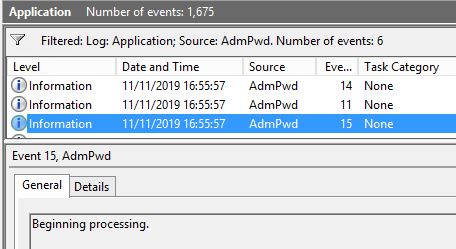
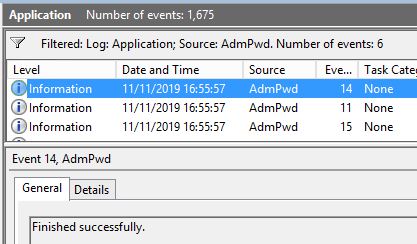
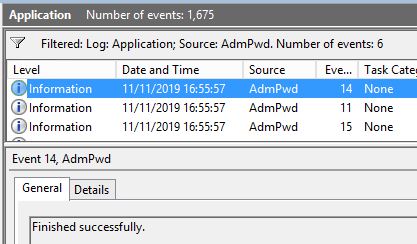
When we refresh the event log, we see event IDs 15, 11 then 14.

Event ID 15: Start of processing LAPS
Event ID 11: LAPS logic
Event ID 14: End of processing LAPS

Reading the events we can see that LAPS took no action because the password expiration date and time on the AD Computer Object for LAB-CTXHOST is 30 days in the future.

Logging Demo: Password Change Required

Using Powershell, we set the expiration date to be in the past. Now we run gpupdate and observe the log entries.

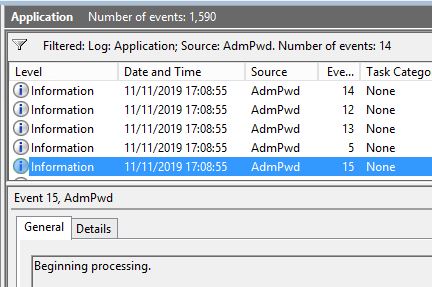
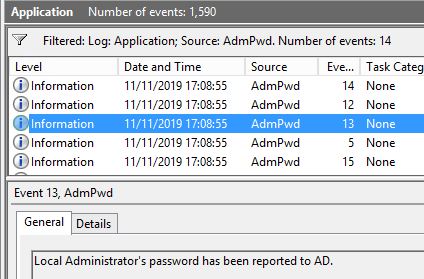
This time we see event IDs 15, 5, 13, 12 then 14.

Event ID 15: Start of processing LAPS
Event ID 5: LAPS has generated a new password and validated it against the GPO controlled password requirements.
Event ID 13: New password successfully written to Active Directory.
Event ID 12: New password successfully updated on the local administrator account.
Event ID 14: End of processing LAPS

Logging Demo: No Domain Controller Available

If the Domain Controller is inaccessible at the start of Group Policy processing, no LAPS log entries will appear. This is because Group Policy processing fails before the LAPS Group Policy Client Side Extension is triggered. LAPS will never reset the password under these conditions.

Logging Demo: No permission over object

During the installation of LAPS, we use the Set-AdmPwdComputerSelfPermission LAPS Powershell module cmdlet to apply the following permission to the Organisational Unit that contains the Computer Objects that are due to receive LAPS.

  • Principal: SELF
  • Permission: Write ms-Mcs-AdmPwd
  • Applies to: Descendent Computer Objects

This allows the devices to update their passwords in Active Directory.

We have now removed this permission for LAB-CTXHOST and used the LAPS Powershell module cmdlet Reset-AdmPwdPassword to set an expiration date and time that is in the past.

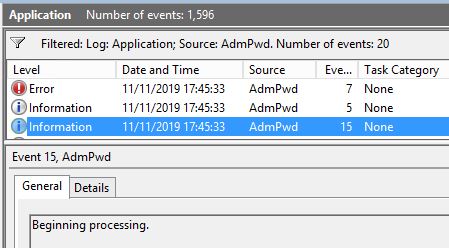
After running gpupdate we see the event IDs 15, 5 and 7.

Event ID 15: Begin processing LAPS
Event ID 5: LAPS has generated a new password and validated it against the GPO controlled password requirements.
Event ID 7: LAPS fails to write the password to AD

Summary

We have seen that using the Windows Event Log, we can view to a granular level which step of the LAPS process has failed. In production, logging level 1 (Errors and Warnings) should suffice and most monitoring solutions can be configured to read these logs entries and generate alerts.